
Most people treat the brain like a passenger.
They wake up, react to the day, respond to stimulation, and call it living. They assume thought just happens — automatic, uncontrolled, inevitable.
It isn’t.
Cognition is a system. And like every system, it can be understood, trained, and optimized.
What Cognition Actually Is
Cognition is the collective term for the mental processes that drive how you perceive, process, and respond to information.
It includes attention, memory, reasoning, decision-making, and problem-solving. These aren’t abstract concepts. They are measurable functions executed by specific brain structures operating on electrochemical signals.
When your cognition is sharp, you filter noise efficiently, retain relevant information, make faster decisions, and sustain focus under pressure.
When it isn’t, everything costs more — mentally and physically.
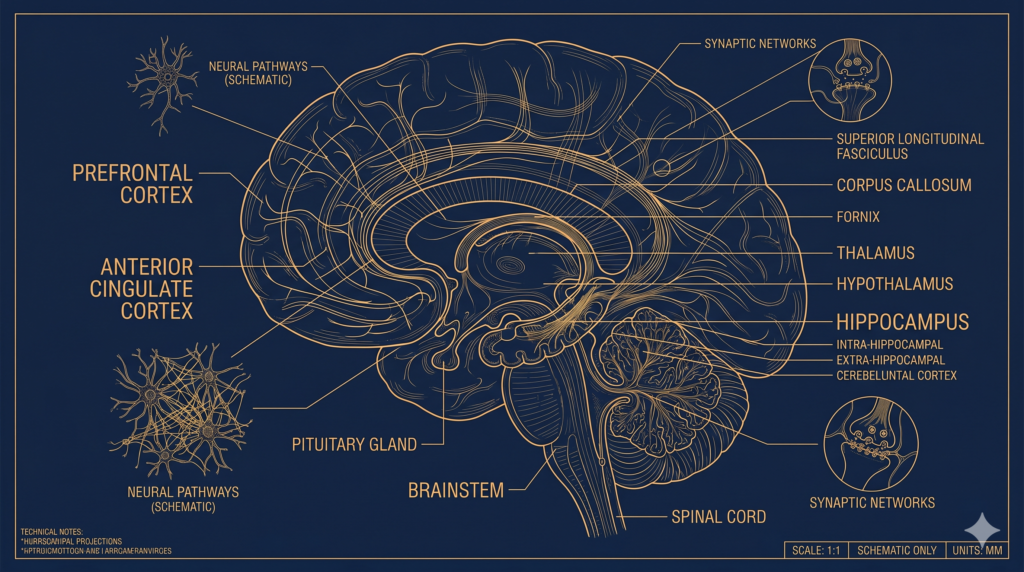
The Brain Structures Involved
Three regions are central to disciplined cognitive function:
The Prefrontal Cortex — located at the front of the brain, directly behind the forehead. This is the seat of executive function. Planning, impulse control, goal-directed behavior, and rational decision-making all originate here. When this region is well-regulated, you act with intention. When it’s compromised — by stress, poor sleep, or chronic distraction — you react instead of respond.
The Hippocampus — the brain’s primary memory consolidation center. It converts short-term experience into long-term knowledge. Consistent learning, pattern recognition, and skill retention depend on hippocampal health. Exercise, sleep, and low chronic stress directly support its function.
The Anterior Cingulate Cortex — the region responsible for error detection and conflict monitoring. It flags when your behavior diverges from your intentions. This is the biological mechanism behind self-awareness. A trained anterior cingulate cortex is what separates people who course-correct from people who rationalize.
How Discipline Shapes Cognition
Discipline is not a personality trait. It is a cognitive pattern reinforced through repeated behavior.
Every time you choose action over avoidance, your prefrontal cortex strengthens its inhibitory control over the limbic system — the brain’s emotional and reward-driven region. You are, at a neurological level, training your brain to override impulse with intention.
This is not motivation. Motivation is limbic. It fluctuates based on emotional state, dopamine availability, and environmental stimulation.
Discipline is cortical. It operates independently of how you feel.
What the Research Confirms
Neuroimaging studies consistently show that individuals with high self-regulatory capacity demonstrate greater prefrontal cortex activation during decision-making tasks. They process competing impulses without being governed by them.
Research on cognitive load confirms that mental fatigue degrades decision quality — not because willpower runs out, but because glucose metabolism in the prefrontal cortex depletes under sustained demand. This is why sleep, nutrition, and recovery are not optional variables in cognitive performance. They are inputs.
The brain is not fixed. Its structure responds to behavior. This is the core principle of neuroplasticity — and it is the subject of the next Cortex Chronicles entry.
The Takeaway
Your cognitive performance is not determined by talent or genetics alone.
It is shaped by what you consistently do — how you sleep, how you move, what you consume, and how you direct your attention.
The disciplined mind is not born. It is built.
And it starts with understanding the system you are working with.
Discover more from wellnesswaynews.com
Subscribe to get the latest posts sent to your email.