
Fitness & Movement

Functional Fitness Strategies for Every Age

Wellness Techniques That Shift Your State in Real Time

Wellness is often framed as something that happens over time, through routines, habits, and long-term commitments. While that’s true, there is another side of wellness that matters just as much. The ability to shift your physiology and mental state in the moment. Stress is not just psychological. It is physiological. Heart rate increases, breathing becomes […]

Wellness Techniques That Shift Your State in Real Time Read More »
The 5-3-1 Strength Template: A Proven System for Long-Term Gains

Most people fail at the gym because they have no plan. They wander from machine to machine, chase pump, and wonder why they’re not getting stronger. Jim Wendler’s 5/3/1 program is one of the most effective strength-building templates ever designed. It’s simple, scalable, and built for long-term progression. No gimmicks. No complexity. Just disciplined, consistent

The 5-3-1 Strength Template: A Proven System for Long-Term Gains Read More »

Progressive Overload and Adaptation: The Only Training Principle That Matters

Your body adapts to stress. That’s it. That’s the entire science of fitness. Progressive overload—the gradual increase of stress placed on the body during training—is the cornerstone of strength, hypertrophy, endurance, and performance. Without it, you’re just spinning your wheels. The principle is simple: do more over time. More weight, more reps, more sets, more

Progressive Overload and Adaptation: The Only Training Principle That Matters Read More »

The Neuroscience of Discipline: Why Your Brain Needs Structure to Thrive

Your brain doesn’t respond to motivation. It responds to patterns. Neuroscience reveals that discipline—not fleeting inspiration—is what rewires neural pathways and builds lasting change. When you commit to a consistent routine, you’re not just building habits. You’re literally restructuring your prefrontal cortex, the command center for decision-making, impulse control, and long-term planning. Research from Stanford

The Neuroscience of Discipline: Why Your Brain Needs Structure to Thrive Read More »

Thursday’s Thoughts: Stop Chasing the “Perfect” Exercise

Is one exercise really better than another? Possibly. But here’s what nobody talks about: if you don’t know how to work the muscle itself, switching exercises won’t change your results—it might make them worse. Back in the day, experts said you couldn’t bench press every day. Now everyone’s doing legs daily. What changed? The answer is simple: what works for YOU is what matters.

Thursday’s Thoughts: Stop Chasing the “Perfect” Exercise Read More »

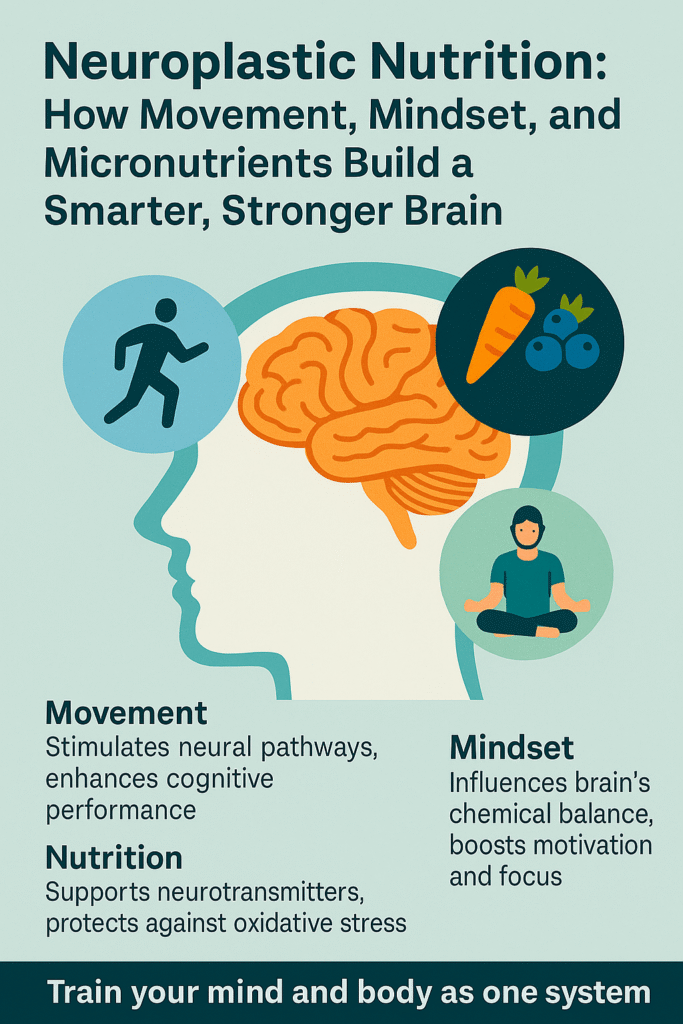
Neuroplastic Nutrition: How Movement, Mindset, and Micronutrients Build a Smarter, Stronger Brain

Your brain is not fixed—it’s in constant motion. Every rep, every mindful breath, and every nutrient you consume shapes its structure and sharpens its function. Learn how targeted movement, nutrition, and mindset training create an adaptable, high-performing brain built for focus, memory, and resilience.

Neuroplastic Nutrition: How Movement, Mindset, and Micronutrients Build a Smarter, Stronger Brain Read More »

Strength for Life

Functional Fitness Strategies for Every Age Strength isn’t just about lifting heavier weights—it’s about moving through life with ease, stability, and confidence. Functional fitness trains your body for real-world activities, from carrying groceries to climbing stairs, so you can stay strong at every stage of life. Why Functional Fitness Matters Mimics daily movement patterns (push,

Strength for Life Read More »

Recovery First

Why ‘Rest Days’ Are the Smartest Part of Your Training Hard work builds strength—but recovery is where the real progress happens. Rest days aren’t a sign of weakness—they’re an essential training tool. The Science of Recovery Muscles repair and grow during rest, not workouts. Prevents overtraining syndrome (fatigue, injury, burnout). Improves nervous system function and

Recovery First Read More »